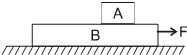
A block A of mass m kg lies on block B of mass m kg. B in turn lies on smooth horizontal plane. The coefficient of friction between A and B is µ. Both the blocks are initially at rest. A horizontal force F is applied to lower block B at t = 0 such that there is relative motion between A and B. In the duration from t = 0 second till the lower block B undergoes a displacement of magnitude L, match the statements in column-I with results in column-II .
Column-I | Column-II |
(a) Work done by friction force on block A is | (p) positive |
(b) Work done by friction force on block B is | (q) negative |
(c) Work done by friction on block A plus work done by friction on block B is | (r) less than µmgL in magnitude |
(d) Work done by force F on block B is | (s) equal to µmgL in magnitude |
Text Solution
Verified by ExpertsCHECK THE SOLUTION.
p, r - q, s - q, r - p
Sol. The displacement of A shall be less than displacement L of block B.
Hence work done by friction on block A is positive and its magnitude is less than µmgL.
And the work done by friction on block B is negative and its magnitude is equal to µmgL.
Therefore, workdone by friction on block A plus on block B is negative its magnitude is less than µmgL.
Work done by F is positive. Since F>µmg, magnitude of work done by F shall be more than µmgL.
Prepare Smarter with CGP Edu
Get practice questions, solutions, and test series in one place.
Write a Review
Share your experience with this question and solution.
Commentary
Send your comment, doubt, correction, or feedback to admin.
Similar Questions
Explore conceptually related problems